
Ban the box has moved from a handful of cities to a nationwide compliance reality: roughly 35 to 37 states plus Washington, D.C. and more than 150 local governments now have fair chance hiring laws. With more than 70 million Americans holding a criminal record, these laws reshape when and how employers can consider criminal history, and getting the timing wrong can trigger penalties into six figures.
- Roughly 35 to 37 states plus D.C. and more than 150 cities and counties have adopted ban the box or fair chance policies (NELP).
- Only about 12 to 15 states extend these laws to private employers; most cover public hiring or government contractors only.
- More than 70 million Americans, nearly one in three adults, have an arrest or conviction record (NELP / EEOC).
- Ban the box regulates timing, not whether you can screen: employers can still run compliant background checks, just later in the process.
- The EEOC framework requires a targeted screen (nature of offense, time elapsed, nature of job) plus an individualized assessment.
- Enforcement is real: one jurisdiction issued over $500,000 in penalties in a single year, with per-violation fines reaching into the tens of thousands.
What’s in This Report
- Ban the Box Coverage: States, Cities, and the Private Sector
- The Size of the Fair Chance Workforce
- What Ban the Box Actually Regulates
- The EEOC Framework and Individualized Assessment
- Penalties and Compliance Risk
- Employment, Recidivism, and Business Outcomes
- Summary Data Table
- Frequently Asked Questions
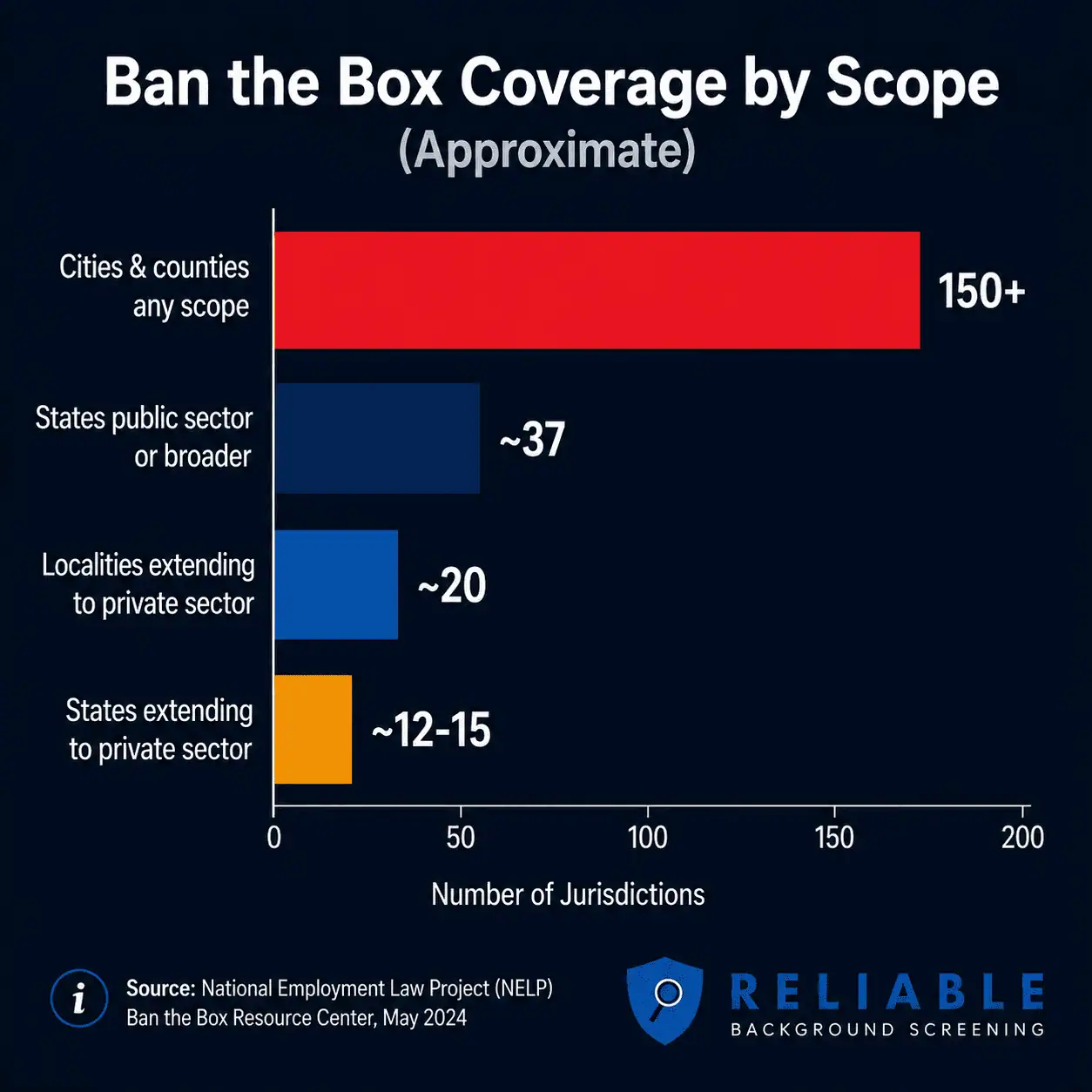
Most fair chance laws cover public hiring; far fewer reach private employers (Source: NELP).
1 Ban the Box Coverage: States, Cities, and the Private Sector
The fair chance movement is now national in scope. The National Employment Law Project (NELP), which maintains the most comprehensive tracking of these laws, reports that roughly 35 to 37 states plus the District of Columbia have adopted a ban the box or fair chance policy, alongside more than 150 cities and counties. The exact state count varies by source and by how “adoption” is defined, but the trajectory is unambiguous: coverage has expanded steadily for more than a decade.
The most important distinction for employers is public versus private coverage. The large majority of ban the box laws apply only to government hiring or to government contractors. A smaller group, roughly 12 to 15 states plus D.C. and around 20 localities, extends the requirements to private-sector employers. For a multi-state employer, this patchwork is the core compliance challenge: timing rules, notice requirements, and lookback limits differ by state, and local ordinances frequently layer stricter rules on top.
Ban the Box Coverage by Scope (Approximate, NELP)
Source: National Employment Law Project
Get the disclosure and timing details right from the start
2 The Size of the Fair Chance Workforce
Ban the box exists because the population affected is enormous. More than 70 million Americans, nearly one in three adults, have an arrest or conviction record on file with a state or federal agency, according to figures cited by NELP and the EEOC. That count reflects any fingerprinted arrest submitted to a database, so it is higher than a count limited only to convictions, but it captures the scale of the barrier: a record touches a third of the adult workforce.
The economic stakes are significant on both sides. For employers navigating a tight labor market, the fair chance population represents a large, often overlooked talent pool. For applicants, the record carries a lasting penalty: research cited by NELP found that formerly incarcerated men can expect to work nine fewer weeks per year and earn about 40 percent less annually. This is the tension fair chance laws attempt to manage, opening access to jobs while preserving an employer’s ability to screen for genuine, job-related risk.
Source: National Employment Law Project | U.S. EEOC
See how second chance hiring can work for employers
3 What Ban the Box Actually Regulates
A persistent misconception is that ban the box prohibits background checks. It does not. These laws regulate the timing and sequencing of criminal history inquiries. The name refers to the check-box on job applications asking whether the applicant has a criminal record; ban the box removes that box and delays the inquiry until later in the process, typically after an interview or a conditional offer.
Employers retain the right to run thorough, compliant background checks. What changes is the workflow: the check happens after the candidate has been evaluated on qualifications, and adverse decisions based on criminal history must follow specific notice and assessment steps. For screening providers and employers alike, this makes process design, when the check runs, how results are reviewed, and how adverse action is handled, the center of compliance.
Combining two data points shows why this is operationally hard. NELP tracks 35 to 37 states plus 150+ localities with fair chance rules, and the EEOC layers a federal framework on top for employers with 15 or more employees.
Interpretation: a national employer can face well over 150 overlapping jurisdictional rule sets governing a single moment in hiring, when and how criminal history enters the decision, on top of federal Title VII and FCRA obligations. Compliance is less about any one law and more about a repeatable, jurisdiction-aware process. Sources: NELP fair chance guide; EEOC enforcement guidance. Calculation and interpretation original to Reliable Background Screening.
Source: U.S. EEOC Best Practices
Master the adverse action process step by step
4 The EEOC Framework and Individualized Assessment
Underlying nearly every fair chance law is the EEOC’s enforcement guidance on the use of arrest and conviction records. It rests on a simple principle: blanket exclusions of anyone with a record risk violating Title VII because they can produce a disparate impact. Instead, the EEOC directs employers toward a targeted screen and an individualized assessment.
The targeted screen draws on the three factors courts identified in Green v. Missouri Pacific Railroad: the nature and gravity of the offense, the time that has passed since the offense or completion of the sentence, and the nature of the job sought. The individualized assessment then gives a screened-out applicant notice, an opportunity to explain their circumstances, and genuine consideration of that information before a final decision. The EEOC also stresses that an arrest, unlike a conviction, does not by itself establish that criminal conduct occurred.
Source: U.S. EEOC Q&A on Enforcement Guidance
Read the EEOC guidelines in practical detail
5 Penalties and Compliance Risk
Fair chance laws have teeth. Enforcement mechanisms vary by jurisdiction, but penalties are real and escalating. In one 2019 enforcement year, the District of Columbia issued more than $500,000 in penalties for violations of its fair chance screening law. Per-violation fines in some jurisdictions escalate progressively, reaching $5,000, $10,000, and $20,000 for repeated violations, and some localities provide liquidated damages for each day a violation continues.
The compounding risk is that fair chance violations often travel with FCRA violations. An employer that mishandles the timing of a criminal inquiry frequently also mishandles the disclosure, authorization, or adverse-action steps that the FCRA requires, exposing the organization to both regulatory penalties and class-action litigation. This is why fair chance compliance is best handled as one integrated workflow rather than as isolated legal checkboxes.
Progressive Per-Violation Fine Structure (Illustrative, Select Jurisdictions)
Source: SHRM Vendor Directory / Compliance Guide
Run compliant, well-timed employment screening
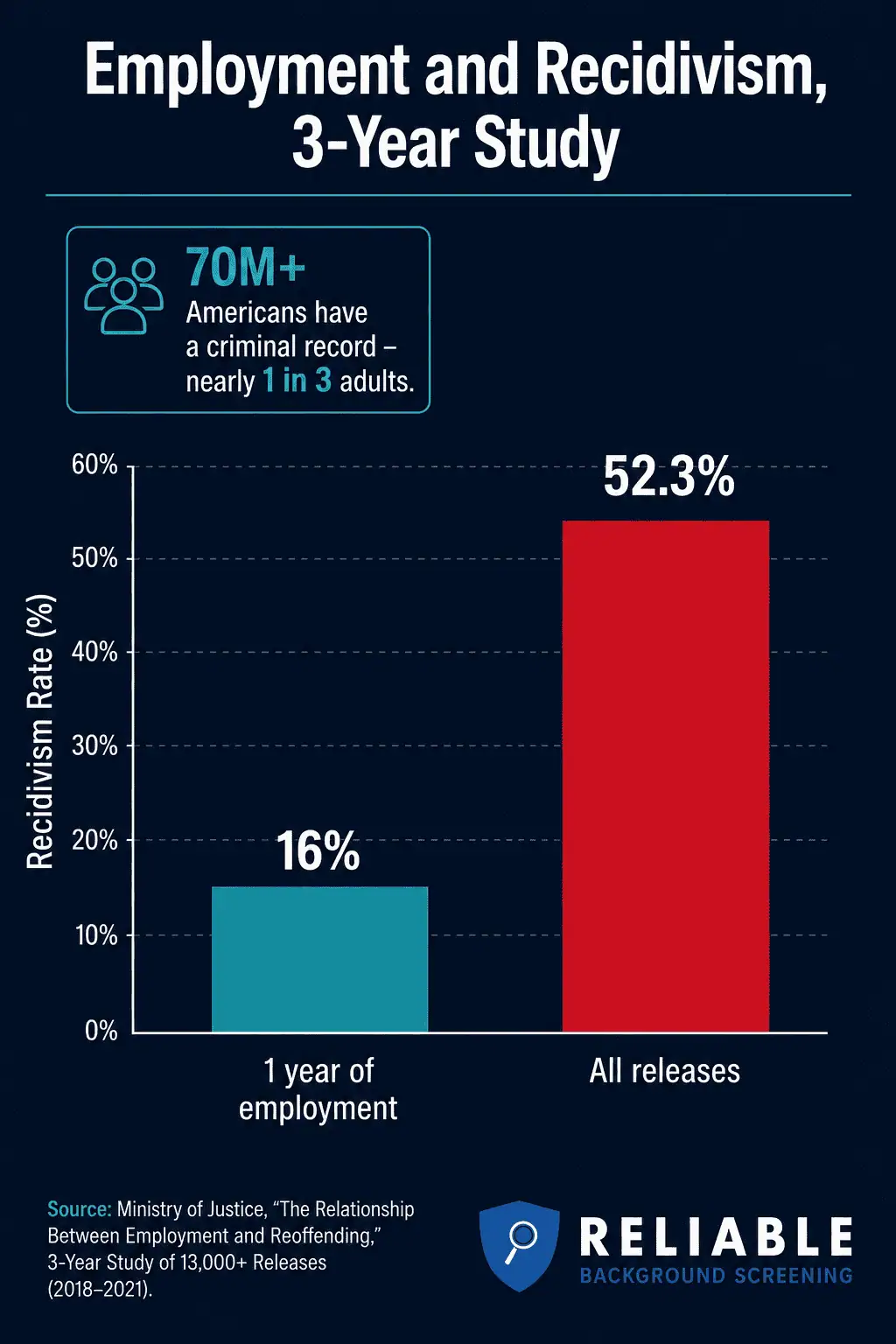
Employment is the single strongest predictor of reduced recidivism (Source: study cited by NELP).
6 Employment, Recidivism, and Business Outcomes
The policy rationale behind fair chance hiring is backed by outcome research. Studies cited by NELP found that employment is the single most important factor in reducing recidivism. In one three-year study, formerly incarcerated people with a year of employment had a 16 percent recidivism rate, compared with a 52.3 percent rate for all releases, a dramatic difference that links stable work to public safety.
For employers, the practical implication is that fair chance hiring, done with a sound individualized-assessment process, expands the qualified talent pool without abandoning safety. The goal of a well-designed program is not to ignore criminal history but to evaluate it accurately and fairly, screening for genuine job-related risk while giving qualified applicants with records a real path to employment.
Source: National Employment Law Project
Talk to an FCRA-certified advisor about fair chance compliance
Ban the Box and Fair Chance Hiring Statistics 2026: Summary Table
| Statistic | Figure | Source | Year |
|---|---|---|---|
| States with ban the box / fair chance policy | 35–37 + D.C. | NELP | 2025–2026 |
| Cities and counties with fair chance policies | 150+ | NELP | 2025–2026 |
| States extending to private employers | ~12–15 | NELP | 2025–2026 |
| Localities extending to private employers | ~20 | NELP | 2025–2026 |
| Americans with an arrest or conviction record | 70 million+ | NELP / EEOC | current |
| Share of adults with a record | ~1 in 3 | NELP / EEOC | current |
| People re-entering communities annually | ~700,000 | NELP | current |
| Title VII employee threshold | 15+ | EEOC | current |
| Targeted screen factors | 3 (offense, time, job) | EEOC | current |
| Common lookback limit | 7 years | State statutes | current |
| Single-jurisdiction penalties in one year | $500,000+ | D.C. / NELP | 2019 |
| Progressive per-violation fines | $5K / $10K / $20K | Select jurisdictions | 2025 |
| Recidivism with 1 year of employment | 16% | NELP-cited study | current |
| Recidivism, all releases (same study) | 52.3% | NELP-cited study | current |
| Earnings penalty, formerly incarcerated men | ~40% lower | NELP-cited | current |
Frequently Asked Questions
How many states have ban the box laws in 2026?
How many ban the box laws cover private employers?
How many Americans have a criminal record?
Does ban the box mean employers cannot run background checks?
What does the EEOC require when using criminal records in hiring?
Methodology and Sources
This report compiles ban the box and fair chance hiring statistics from Tier 1 sources. Counts of states, cities, and counties with fair chance policies, and the breakdown of public versus private-sector coverage, are drawn from the National Employment Law Project (NELP), which maintains the most widely cited tracking of these laws. Because NELP and secondary trackers count “adoption” slightly differently (some count executive orders, some only statutes, and coverage changes over time), state counts are presented as a range (approximately 35 to 37 states plus D.C.). Figures on the size of the population with criminal records (70 million+; roughly one in three adults) are from NELP and the EEOC. The compliance framework, including the targeted screen, the three Green v. Missouri Pacific factors, and the individualized assessment, is from the EEOC’s enforcement guidance on arrest and conviction records. Penalty figures reference specific jurisdictional enforcement actions and fine schedules as reported in compliance guidance.
Recidivism and earnings figures are from studies cited by NELP rather than original data collected here, and are attributed accordingly. Lookback limits and private-sector counts vary by jurisdiction and change as new laws pass; readers should verify the current rule for any specific state or locality before relying on it. This report is educational and is not legal advice. Statistics that could not be traced to a primary or authoritative source have been excluded.