
In 2024 the CFPB logged more than 2.8 million consumer complaints, and roughly 85 percent concerned credit and consumer reporting, the category that includes background checks. The overwhelming theme across that data is accuracy: the single most common complaint, year after year, is that a report simply contained wrong information about the consumer.
- The CFPB received more than 2.8 million consumer complaints in 2024, and credit and consumer reporting was the largest category at about 85 percent of all complaints (CFPB Consumer Response Annual Report).
- The most common complaint across years is incorrect information on a consumer report, followed by improper use of a report and problems with dispute investigations.
- Tenant screening generated roughly 26,700 complaints from January 2019 to September 2022, with monthly volume climbing from about 300 to nearly 700 (CFPB Consumer Snapshot).
- FCRA enforcement has produced penalties including $2.6M, $5.8M, and a historic $10M, with a proposed settlement exceeding $43M (FTC / DOJ).
- The CFPB has affirmed that matching consumer records by name alone is illegal under the FCRA, because it produces false identifications.
- The lesson for buyers: complaints cluster around low-cost, database-only reporting, not around court-verified, source-confirmed screening.
What’s in This Report
1 Consumer Complaint Volume and Where Reporting Ranks
The scale of consumer reporting complaints is easy to underestimate. The CFPB’s 2024 Consumer Response Annual Report documented more than 2.8 million complaints submitted by consumers across all 50 states, routed to over 3,600 companies for response. Credit and consumer reporting, the umbrella category that includes background and tenant screening reports, was by far the largest, at roughly 85 percent of all complaints. The majority were directed at the three nationwide consumer reporting agencies.
This is not a one-year spike. Consumer reporting has been the dominant complaint category for years and has been growing. An analysis of the complaint database found that from January 2020 through September 2024, nearly five million complaints were logged, and close to 80 percent concerned credit reporting, including incorrect information and improper use of reports. Complaint totals set a record of about 496,000 in 2021, then jumped to roughly 800,000 in 2022, with national consumer reporting agencies driving the increase.
Credit and Consumer Reporting Share of All CFPB Complaints
Source: CFPB Consumer Response Annual Report 2024 | Congressional Research Service
See how accuracy-first screening avoids these complaints
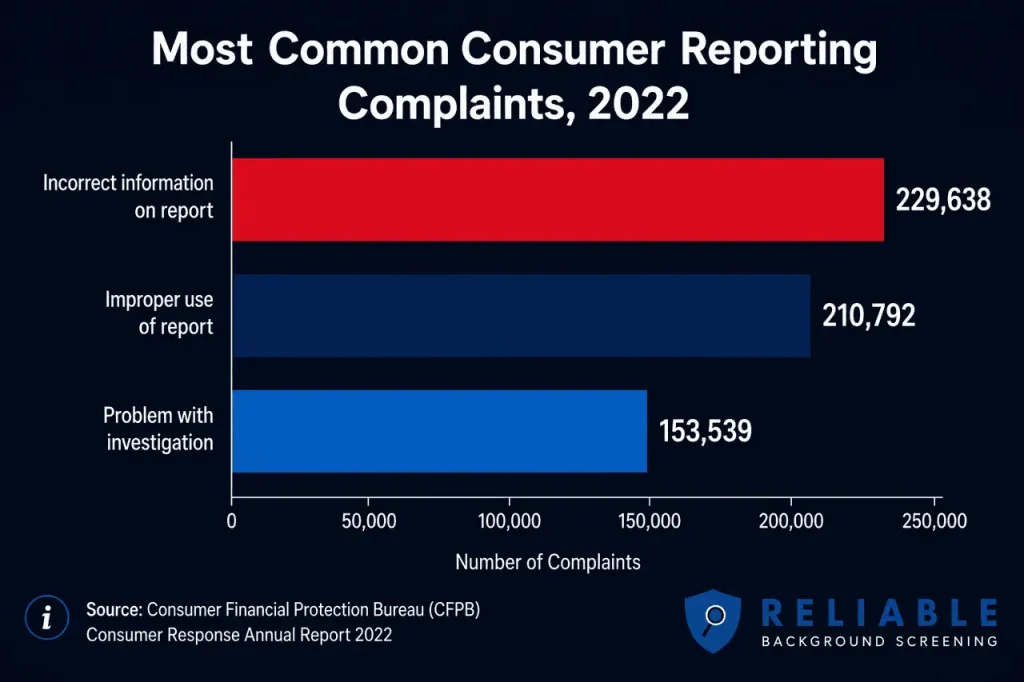
Incorrect information leads all consumer reporting complaints (Source: CFPB Consumer Complaint Database).
2 The Most Common Background Check Complaints
When consumers explain what went wrong, the pattern is remarkably consistent. The top issues are incorrect information on the report, improper use of the report, and problems getting the reporting company to properly investigate a dispute. In 2022, a representative year, incorrect information drew 229,638 complaints, improper use drew 210,792, and problems with a company’s investigation drew 153,539.
| Complaint Issue | Volume (2022) | What It Means |
|---|---|---|
| Incorrect information on report | 229,638 | Wrong records, mismatched identity, outdated data |
| Improper use of report | 210,792 | Report pulled or used without a permissible purpose |
| Problem with investigation | 153,539 | Dispute not reasonably investigated or corrected |
| Attempts to collect debt not owed | 31,112 | Adjacent debt-collection issue tied to bad data |
Identity theft and fraud-related complaints rose notably in 2024, with consumers frustrated that agencies did not consistently remove disputed items even after they supplied police reports or FTC identity theft reports. That intersection, where a data error meets a slow or inadequate dispute process, is precisely where regulatory scrutiny and litigation concentrate.
Source: CFPB Consumer Complaint Trends (2024)
Understand FCRA-compliant credit and background reporting
3 Tenant Screening Complaint Statistics
Tenant screening is a concentrated example of the broader accuracy problem. In its Consumer Snapshot on tenant background checks, the CFPB analyzed complaints and found renters submitted roughly 26,700 tenant-screening-related complaints between January 2019 and September 2022. Monthly volume roughly doubled over that window, rising from about 300 complaints per month to nearly 700.
The nature of the complaints mirrors the employment side: the vast majority alleged incorrect information on a prospective renter’s report, followed by difficulty getting companies to fix the errors. Because landlords frequently make an instant decision based on a proprietary risk score, a single inaccurate record, an expunged case, an eviction filing that never became a judgment, or a record belonging to someone else, can cost an applicant housing and the application fee.
Interpretation: each inaccurate tenant report that triggers a denial can cost the applicant both the housing opportunity and a non-refundable fee, so tens of thousands of complaints represent a real, compounding financial burden on renters, not just a paperwork dispute. Source: CFPB Consumer Snapshot: Tenant Background Checks. Calculation and interpretation original to Reliable Background Screening.
Source: CFPB: Problems with Tenant Background Checks
Learn about accurate resident and tenant screening
4 Why Inaccuracy Drives the Complaints
The complaints are not random. They trace to identifiable practices that the CFPB has repeatedly flagged. In a 2024 advisory opinion, the CFPB affirmed that consumer reporting agencies must maintain reasonable procedures to avoid producing reports with false or misleading information, and specifically that matching consumer records solely by name is illegal under the FCRA. Name-only matching is a primary source of the mismatched-identity errors that dominate complaints.
The CFPB’s guidance also directs agencies to report disposition information for arrests, charges, and eviction filings; to avoid reporting expunged or sealed records; and to prevent duplicative entries. Each of these directives targets a specific, documented error type. The National Consumer Law Center has pushed further, recommending that screening companies be required to verify automated database hits against the record’s original source before reporting, exactly the practice that separates thorough providers from database resellers.
Source: CFPB Advisory Opinion on Background Screening (2024) | National Consumer Law Center
Choose source-verified employment screening
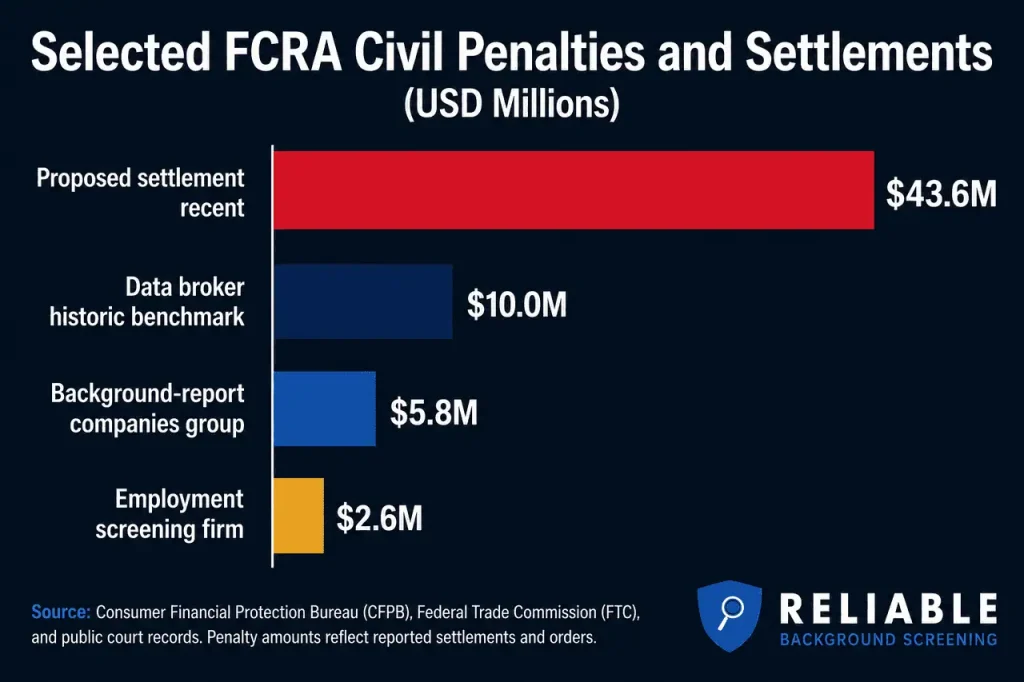
FCRA enforcement has produced multimillion-dollar penalties against screening and background-report companies (Source: FTC, DOJ).
5 FTC and CFPB Enforcement and Penalties
Complaints translate into enforcement, and the penalties are substantial. The FTC and Department of Justice have pursued FCRA cases against screening and background-report companies for years. Notable civil penalties include $2.6 million against an employment background screening firm for accuracy and file-disclosure failures, and $5.8 million against a group of background-report companies for deceptive practices and operating as consumer reporting agencies without following FCRA requirements. The historic benchmark remains a $10 million penalty against a consumer data broker.
Selected FCRA Civil Penalties and Settlements (USD Millions)
Beyond headline penalties, class-action exposure is a persistent risk. Even procedural FCRA failures, such as improper disclosure and authorization forms or botched adverse-action sequencing, routinely produce settlements exceeding $1 million. Regulators have also made clear that AI-driven screening tools remain fully subject to the FCRA, so automation does not reduce compliance obligations.
Source: U.S. Department of Justice | FTC Settlement Coverage
Ask an FCRA-certified advisor how to reduce compliance risk
6 What the Complaint Data Means for Buyers
Read together, the complaint statistics point to one conclusion for employers, landlords, and organizations: the risk in background screening is concentrated in accuracy and dispute handling, and those risks scale with how a report is produced. Cheap, database-only checks that match on names and skip source verification are overrepresented in the complaint and enforcement data. Court-verified screening with sound matching procedures and a real dispute process is the direct countermeasure.
For a mid-market or enterprise buyer, the practical filter is straightforward: ask a prospective provider how they match records, whether they verify database hits against original sources, how they handle disputes, and how they keep adverse-action sequencing compliant. Providers who cannot answer clearly are the ones who show up in the data above.
Source: CFPB Tenant Background Checks Resources
Compare comprehensive, compliant screening services
Background Screening Consumer Complaint Statistics 2026: Summary Table
| Statistic | Figure | Source | Year |
|---|---|---|---|
| Total CFPB consumer complaints | 2.8 million+ | CFPB | 2024 |
| Credit/consumer reporting share of complaints | ~85% | CFPB | 2024 |
| Credit reporting share (FY2023) | 80.5% | CRS / CFPB | 2023 |
| Complaints logged Jan 2020–Sep 2024 | ~5 million | CBA / CFPB database | 2020–2024 |
| Companies routed complaints | 3,600+ | CFPB | 2024 |
| Incorrect information complaints | 229,638 | CFPB database | 2022 |
| Improper use of report complaints | 210,792 | CFPB database | 2022 |
| Dispute investigation complaints | 153,539 | CFPB database | 2022 |
| Tenant screening complaints | ~26,700 | CFPB | 2019–2022 |
| Tenant complaint monthly growth | ~300 to ~700 | CFPB | 2019–2022 |
| Name-only matching status | Illegal under FCRA | CFPB advisory opinion | 2024 |
| FCRA penalty (employment screening firm) | $2.6 million | FTC / DOJ | historic |
| FCRA penalty (background-report companies) | $5.8 million | FTC | 2023 |
| FCRA penalty (data broker benchmark) | $10 million | FTC | historic |
| Proposed FCRA settlement | $43.6 million | FTC | recent |
| States restricting employment credit checks | ~13 | Industry / statutory | 2025 |
Frequently Asked Questions
How many consumer complaints does the CFPB receive about credit and background reporting?
What is the most common background check complaint?
How common are complaints about tenant screening reports?
What penalties have background check companies faced for FCRA violations?
Why do so many background check complaints involve inaccurate information?
Methodology and Sources
This report compiles consumer complaint statistics for the background screening and consumer reporting industry from Tier 1 government and primary sources. Aggregate complaint volumes and category shares are drawn from the CFPB Consumer Response Annual Report (2024) and the CFPB Consumer Complaint Database, supplemented by the Congressional Research Service’s analysis of FY2023 data. Tenant screening figures are from the CFPB’s “Consumer Snapshot: Tenant Background Checks” and its accompanying market report. Issue-level complaint counts (incorrect information, improper use, investigation problems) reflect CFPB database figures for 2022 as reported in public analyses. Regulatory standards, including the affirmation that name-only matching is illegal, are from the CFPB’s January 2024 advisory opinion on background screening. Enforcement penalties are from FTC press releases and Department of Justice filings.
Complaint category shares vary slightly by report and reporting period (for example, ~80.5% in FY2023 CRS data versus ~85% in the 2024 annual report) because of differing date ranges and category definitions; ranges are shown where appropriate. Enforcement figures reference specific, named cases and are labeled as historic where the action predates the current reporting year. Statistics that could not be traced to a primary government or regulatory source have been excluded.
Posted by: Rudy Troisi, L.P.I., Founder, CEO, and Dr. Alan Lasky, SVP Business Development and Partnerships.
This content is for informational purposes only and not legal advice or binding case law. Consult qualified legal counsel for assistance.
Copyright © 2026, Reliable Background Screening, a Division of Marcett, Inc. All rights reserved.